


 English
 Español
 Portugues
 Pусский
 Français
 日本語
日本語 한국어
한국어 العربية
 Italiano
 Polski
 हिन्दी
 Indonesia
 Melayu
 Tiếng Việt
 中文
中文 қазақ
қазақ বাংলা
বাংলা မြန်မာ
 فارسی
فارسی українська
 اردو
اردو ಕನ್ನಡ
ಕನ್ನಡ kiswahili
 मराठी
मराठी ଓଡିଆ
ଓଡିଆ


Industrielle Rollenbahn
Industrial Roller Conveyor: A Comprehensive OverviewIndustrial roller conveyors are a critical component in modern material handling systems, designed to streamline the movement of goods within manufacturing, warehousing, and distribution facilities. These conveyors utilize a series of rollers mounted on a frame to transport items efficiently, reducing manual labor and enhancing productivity. Their versatility, reliability, and adaptability make them indispensable in various industries, including automotive, food and beverage, e-commerce, and logistics. Design and ComponentsThe core structure of an industrial roller conveyor consists of multiple cylindrical rollers, typically made from durable materials such as steel, aluminum, or plastic, depending on the application. These rollers are evenly spaced along the conveyor frame, which is constructed from robust materials to ensure stability and longevity. The frame can be customized in terms of width, length, and height to suit specific operational needs.Roller conveyors are powered in two primary ways: gravity-driven or motorized. Gravity roller conveyors rely on the natural slope of the conveyor to move items, making them cost-effective and energy-efficient for lighter loads. Motorized roller conveyors, on the other hand, use electric motors to drive the rollers, providing precise control over the speed and direction of the transported goods. This makes them ideal for heavy-duty applications or environments requiring automation. Applications and BenefitsIndustrial roller conveyors are used in a wide range of applications, from simple material transport to complex assembly lines. They are particularly effective for handling pallets, cartons, drums, and other rigid or semi-rigid items. In manufacturing, they facilitate the seamless movement of components between workstations, while in warehousing, they expedite the loading and unloading of goods.One of the key advantages of roller conveyors is their ability to reduce manual handling, minimizing the risk of workplace injuries and improving operational efficiency. They also offer flexibility, as modular designs allow for easy reconfiguration to accommodate changing production needs. Additionally, their low maintenance requirements and long service life make them a cost-effective solution for businesses. Customization and IntegrationModern industrial roller conveyors can be tailored to meet specific operational requirements. Options include adjustable roller spacing, varying roller diameters, and specialized coatings to handle delicate or corrosive materials. They can also be integrated with other material handling equipment, such as belt conveyors, chain conveyors, or automated sorting systems, to create a comprehensive logistics solution. Environmental and Safety ConsiderationsWith growing emphasis on sustainability, many roller conveyors are designed with energy-efficient motors and recyclable materials. Safety features such as emergency stop buttons, guardrails, and sensors are often incorporated to ensure compliance with industry standards and protect workers. ConclusionIndustrial roller conveyors are a cornerstone of efficient material handling, offering reliability, versatility, and scalability. Whether used in small-scale operations or large industrial complexes, they play a vital role in optimizing workflows, reducing costs, and enhancing productivity. As industries continue to evolve, roller conveyors will remain a fundamental tool for achieving operational excellence.
Produkt
Kategorie:
-
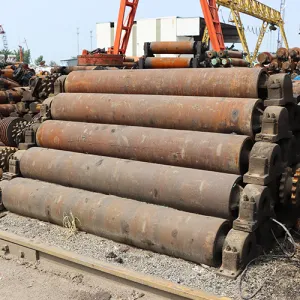
Hochgeschwindigkeits-Rollenbahn
Ihre Klassifizierung: Gebrauchte StahlwalzausrüstungAnsichten: 88Nummer:Veröffentlichungszeit: 2025-08-22 15:12:25Ein Hochgeschwindigkeits-Rollenförderer ist ein Materialtransportgerät, das für industrielle Hochgeschwindigkeitsproduktionslinien entwickelt wurde und häufig in Stahlwerken, Walzwerken, Metallverarbeitungs- und Logistiklagern eingesetzt wird. Es wird hauptsächlich für den schnellen Transport und die kurzfristige Lagerung von Knüppeln, Stahlplatten, Profilen und anderen Metallmaterialien verwendet, wodurch die Effizienz der Produktionslinie und der Logistikumsatz effektiv verbessert werden. Hochgeschwindigkeitsrollenbahnen bestehen typischerweise aus hochfesten Hochgeschwindigkeitsrollen, Stützrahmen, Kraftübertragungseinheiten und automatisierten Steuerungssystemen. Abhängig von den betrieblichen Anforderungen können sie in angetriebene oder nicht angetriebene Förderer eingeteilt werden: Angetriebene Förderer verwenden Motoren, Servosysteme oder hydraulische Antriebe, um einen kontinuierlichen Materialtransport mit hoher Geschwindigkeit zu erreichen, während nicht angetriebene Förderer auf Schwerkraft oder Trägheit angewiesen sind. Moderne Hochgeschwindigkeitsrollenbahnen können mit Sensoren, automatischen Umlenk- und Sortiervorrichtungen, SPS-Steuerungssystemen und Sicherheitsschutzmechanismen für eine intelligente und präzise Materialhandhabung ausgestattet werden. Hochgeschwindigkeits-Rollenförderer zeichnen sich durch schnelle Transportgeschwindigkeit, hohe Tragfähigkeit, robuste Konstruktion, reibungslosen Betrieb und große Anpassungsfähigkeit aus und sind daher unverzichtbare Geräte in leistungsstarken, hocheffizienten industriellen Produktionslinien und automatisierten Logistiksystemen.
Nachrichten
Kategorie:
Keine Suchergebnisse!
Fall
Kategorie:
Keine Suchergebnisse!
Video
Kategorie:
Keine Suchergebnisse!
Herunterladen
Kategorie:
Keine Suchergebnisse!
Rekrutierung
Kategorie:
Keine Suchergebnisse!
Empfohlene Produkte
Keine Suchergebnisse!



 WhatsApp
 Telefon